
01
Intake & seacock
Seawater must enter through an open, unobstructed intake.
Marine air conditioning
Marine A/C adds an entire water circuit to the comfort equation. Sunset Air & Services checks the cabin side, seawater side, controls, drainage, and refrigeration system before recommending a repair, maintenance, or descale.
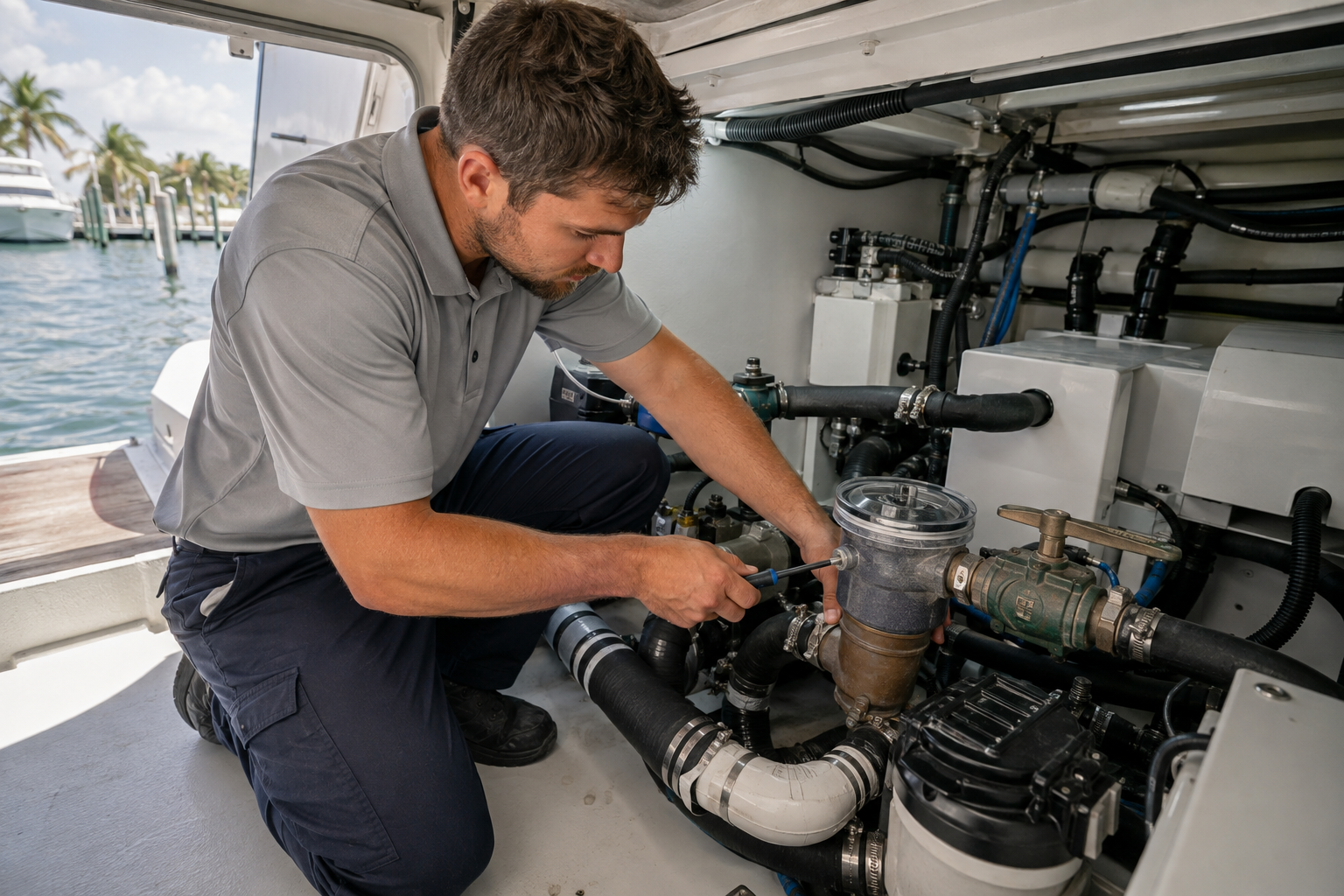
Follow the water
The pump may be running and the system may still have poor flow. Looking at the complete path prevents a dirty strainer, closed intake, airlock, weak pump, fouled condenser, or restricted discharge from being mistaken for a refrigerant problem.
Seawater must enter through an open, unobstructed intake.
The basket catches grass, shells, growth, and debris before they reach the pump.
The pump must stay primed and move enough water for every operating A/C unit.
Heat from the cabin transfers into the seawater circuit here.
Visible discharge confirms water is leaving the circuit, but strength matters too.
Book the right marine visit
Choose service for no cooling, no water discharge, a pump that will not run, recurring error codes, leaks, ice, breaker trips, or a zone that is not operating correctly.
Choose maintenance when the equipment is operating and needs filter, drain, strainer, water-flow, controller, electrical-condition, and performance checks.
A descale is a planned seawater-circuit cleaning based on flow, operating symptoms, growth conditions, service history, system layout, and access—not an automatic refrigerant repair.
Marine owner self-check
These observations help narrow the problem without asking a boat owner to open refrigeration or electrical components.
Set the controller to COOL, lower the setpoint, and allow for its normal start delay. Note whether the display is blank, shows an error, or repeatedly stops. Check only the labeled A/C breaker—do not remove electrical covers or keep resetting a breaker that trips.
Listen for the blower and feel the supply vent. Note whether airflow is strong, weak, warm, cold, or missing. Check the return-air filter and make sure luggage, cushions, or stored gear are not blocking the return or crushing a duct.
From a safe position, look for the marine A/C discharge while the unit is calling. Report whether it is strong, weaker than usual, intermittent, or absent. No discharge is a reason to stop the A/C rather than let the pump run dry.
If the bowl is visible, look for grass, shells, slime, or growth. Only open and clean a strainer if you already know the correct seacock and safe procedure. The A/C must be off, the correct seacock closed, the cap resealed, the seacock reopened, and the system checked for leaks and prime. If you are unsure, leave it alone and call.
Note whether the pump starts, sounds different, cycles, or becomes unusually hot. A pump can run without actually moving water when it has lost prime or has an intake restriction. Do not run it dry or disassemble it onboard unless you are qualified.
Tell us if the boat was recently hauled, the strainer was opened, a hose was removed, or the system sat unused. Those details can point toward lost prime or trapped air even when the pump can be heard.
Look for seawater leaks at accessible hoses, fittings, clamps, the strainer, and pump. Also check the A/C drain pan and condensate hose. Stop the system for an active seawater leak, water near electrical parts, or a pan that is overflowing.
Record the last filter cleaning, sea-strainer cleaning, and condenser descale if known. “Unknown” is useful information. Also note whether discharge flow or cooling has slowly weakened since the last service.
What is a marine A/C descale?
A professional descale isolates the raw-water circuit and circulates a purpose-made marine descaling solution through the condenser or chiller water path. The solution loosens or dissolves marine growth, calcium, lime, rust, and mineral deposits that restrict flow and reduce heat transfer. The circuit is then flushed with fresh water, returned to normal operation, checked for leaks, and verified for discharge flow and cooling performance.
When it may be time
Water temperature, saltwater growth, run time, vessel use, system design, and past service all matter. These clues justify a closer look:
Help us arrive ready
Marine service goes faster when the appointment includes the vessel and system details—not just “the A/C is not cold.”